

When it comes to vehicle-mounted thermal imaging systems, choosing the right IR lens isn’t just about grabbing the highest-spec option available. The selection of vehicle-mounted thermal imaging IR lens requires a careful balance between detection range, field of view, and installation space—three critical factors that can make or break your thermal surveillance operation. At Leedsen Lens, with over 15 years of specialized expertise in precision optics and thermal imaging solutions, we understand that one-size-fits-all doesn’t work when lives and security depend on your equipment.
Why Balance Matters
Vehicle-mounted thermal imaging systems face a unique paradox. You want maximum detection range to identify threats or monitor vast territories. Simultaneously, you need a practical field of view that doesn’t leave blind spots near your vehicle. Yet your mounting space is limited—whether you’re installing on patrol cars, surveillance trucks, or tactical vehicles.
The thermal imaging IR lens you select directly determines your system’s performance across all three dimensions. Detection range, governed by focal length and lens diameter, determines how far you can identify targets. Field of view (FOV), the angular extent your lens captures, defines coverage width. Installation space, your physical mounting constraints, limits what you can actually integrate into your vehicle.
According to industry experts at firms like Raythink, detection distance is determined by factors including target size, lens focal length, and detector performance. However, these factors don’t exist in isolation—they create competing demands that require strategic lens selection.
Detection Range: The Focal Length and Lens Diameter Relationship
Let’s start with detection range, because it’s often the first specification buyers examine. Vehicle-mounted thermal cameras commonly achieve detection ranges between 2-3.5 kilometers for human targets, depending on lens configuration.
Focal length is your primary lever for extending detection range. Longer focal lengths concentrate thermal radiation onto your detector, allowing it to resolve smaller, distant objects. A 50mm lens will achieve human detection at roughly 1.5 km, while a 100mm lens extends that to approximately 2.5 km. For comparison, long-range thermal systems with 1000mm+ focal lengths (like Leedsen Lens’s specialized custom assemblies) achieve detection ranges exceeding 35 kilometers.
However, there’s a physics trade-off: as focal length increases, your field of view contracts significantly. A 25mm lens might deliver a 45-degree horizontal FOV, while a 100mm lens narrows that to 10 degrees. This is where vehicle installation becomes problematic.
Lens diameter (aperture) also impacts detection range. A larger diameter captures more infrared radiation, improving thermal sensitivity and enabling detection in marginal conditions. An f/4.0 lens outperforms an f/5.6 lens when atmospheric conditions aren’t ideal—fog, rain, or particulate matter scatter radiation, and additional light-gathering helps penetrate these conditions.
For vehicle-mounted applications, Leedsen Lens recommends evaluating both MWIR (mid-wave infrared, 3-5 micrometers) and LWIR (long-wave infrared, 8-14 micrometers) options. MWIR lenses often achieve longer detection distances due to shorter wavelengths that experience less atmospheric absorption, making them superior for vehicle-based surveillance where range is prioritized.
Field of View: The Coverage Versus Detail Trade-off
Field of view determines how much ground your system covers simultaneously. This is where the practical constraints of vehicle mounting become apparent.
A wide FOV lens (45+ degrees) captures expansive territory—ideal for perimeter surveillance or tracking moving vehicles across open terrain. A 45-degree lens monitors an area roughly 1.8 times as wide as its distance from the target. For vehicle-mounted applications, this means comprehensive situational awareness around your platform.
However, wide FOV comes at a cost. The same thermal information must be distributed across the entire scene. An object appearing tiny in a wide-FOV image provides fewer pixels for recognition and identification. According to Johnson Criteria (the standard for thermal target recognition), you need at least 0.5 pixels for detection, 1 pixel for recognition, and 2 pixels for identification. Wide-FOV lenses sacrifice this pixel density.
Conversely, narrow-FOV lenses (10-20 degrees) concentrate resolution on smaller areas, enabling precise identification at range. A 75mm thermal lens provides roughly 18-degree FOV, delivering sharp detail on distant targets. But now your vehicle has tunnel vision—you’ll miss activity outside your narrow field.
Leedsen Lens solves this dilemma with motorized zoom thermal lenses. Our 75-1100mm and 90-1100mm f/4.0 zoom assemblies enable operators to maintain wide-area surveillance while quickly pivoting to high-magnification identification. The smooth motorized mechanism (proprietary design built into our custom thermal optics) lets teams maintain situational awareness while obtaining detailed target recognition—a critical advantage for vehicle-mounted operations.
The ideal vehicle-mounted lens balances these needs. Most professional installations opt for 50-75mm focal lengths, achieving 12-18 degree FOVs that preserve detection range (800m-1500m for human targets) while maintaining reasonable coverage width. Some applications add dual-sensor systems with separate wide and narrow thermal lenses—Leedsen Lens custom hardware enables this integration seamlessly.
Installation Space: The Physical Reality Constraint
Here’s where theory meets practice. Vehicle-mounted thermal systems must fit within real-world constraints: turret dimensions, power budgets, weight limits, and mechanical interfaces.
Traditional long-focal-length thermal lenses (100mm+) develop substantial length. A 100mm f/4.0 thermal lens might measure 150-200mm in overall length, not including mechanical adapters. On a compact vehicle turret, this creates overhang problems, vibration issues during movement, and challenges maintaining thermal alignment during shock and recoil.
Compact, shorter thermal lenses (25-50mm) are easier to integrate but sacrifice detection range—a critical trade-off if your security mission requires threat identification at distance.
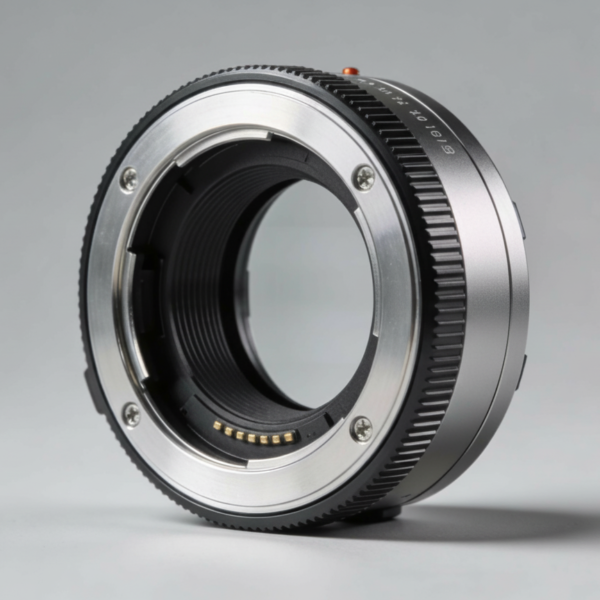
This is where Leedsen Lens’s lens adapter technology becomes invaluable. Our precision lens adapters (available for military-grade thermal cameras and commercial platforms alike) enable mechanical optimization within fixed turret envelopes. Our custom mounting hardware reduces overall system length while maintaining optical performance and thermal image quality.
We also manufacture specialized thermal hardware for vehicle integration: gimbal interfaces, vibration isolation mounts, and thermal management systems that keep optics stable during high-speed operations or weapon firing. These solutions compress installation space while preserving the optical performance you need.
For vehicles with extremely limited mounting space (compact SUVs, drones, lightweight tactical vehicles), Leedsen Lens offers miniaturized thermal lens assemblies with focal lengths of 18-35mm. While these sacrifice some detection range, they fit into spaces where conventional thermal optics won’t mount, and modern detector arrays (capable of 1280×1024 or higher resolution) recover acceptable performance through digital processing.
The Three-Way Balancing Act: Practical Framework
So how do you actually select the right lens for your vehicle-mounted thermal system? Here’s the framework Leedsen Lens applies with clients:
1. Define Your Detection Range Requirement
What’s your minimum identification distance? Border security might require 3km+ human identification. Urban surveillance vehicles might require 1-1.5km. Wildlife monitoring trucks might accept 800m. Start here—this determines your focal length range.
2. Assess Your Field of View Needs
How wide an area must you monitor continuously? Perimeter surveillance demands wider FOV. Tactical targeting vehicles can accept narrower FOV. Balance coverage against your detection range requirement using the FOV/focal length relationship.
3. Evaluate Installation Constraints
Measure your available mounting space precisely. Specify weight limits (vehicle suspension, turret design, and power availability all factor in). Identify mechanical interfaces (standard military mounts, commercial camera interfaces, etc.).
4. Consider Adaptability
Can your system pivot/pan? Can it zoom? Motorized thermal zoom (our specialty) enables a single lens to perform both wide and narrow FOV functions, solving the balance problem elegantly. If fixed mounting is required, select a compromise focal length rather than push performance extremes.
5. Account for Environmental Conditions
Fog, rain, and atmospheric particulates affect thermal performance. If your vehicle operates in marginal conditions, prioritize larger aperture and MWIR wavelength selection over focal length alone.
Vehicle-Mounted Thermal Imaging in Practice
Real-world applications illustrate this balancing act. A border patrol vehicle operating in clear desert conditions might specify a 100mm lens with 10-degree FOV for maximum detection range (2.5km+ human identification), accepting the narrow field of view because the terrain offers visibility and threats emerge predictably.
A law enforcement tactical truck operating in urban environments requires different balance. A 50mm lens with 20-degree FOV provides 1.2km human detection while maintaining awareness of nearby structures. The wider FOV helps operators monitor multiple threat vectors simultaneously.
A drone-mounted thermal system requires completely different compromise. Physical constraints force selection of 25-50mm lenses despite reduced detection range, because payload capacity limits weight strictly. Installation space on a drone airframe measures in centimeters, not meters.
Leedsen Lens has engineered solutions for all three scenarios. Our custom thermal lens assemblies, available as OEM components for camera manufacturers or integration solutions for vehicle integrators, enable precise tuning to your specific constraints. Our lens adapter technology compresses installation footprints. Our motorized zoom mechanisms deliver performance flexibility that static lenses cannot match.
Recommended Solutions for Common Vehicle Platforms
For vehicles prioritizing detection range with moderate installation space: 75mm-100mm f/4.0 thermal lenses with 10-15 degree FOVs, delivering 1.8-2.5km human detection.
For vehicles requiring balanced coverage and range: 50mm f/4.0 thermal lenses with 18-22 degree FOVs and motorized mount, achieving 1.2-1.5km detection while maintaining 35+ meter coverage width at 300 meters.
For compact vehicles or drone integration: Leedsen Lens compact 35mm assemblies with custom mounting adapters, managing 600-800m detection in optimized form factors.
For applications demanding maximum adaptability: Motorized zoom thermal assemblies (75-1100mm) enabling operators to maintain surveillance footprint while obtaining precision identification when threats manifest.
Conclusion: Making the Right Selection
Selection of vehicle-mounted thermal imaging IR lens represents a critical decision that balances competing technical demands against real-world operational constraints. There is no universally “best” choice—optimal solutions are engineered for specific missions, platforms, and environments.
Leedsen Lens has specialized in thermal optics and precision lens manufacturing for 15+ years. Our team understands the physics governing detection range, the practical mathematics of field of view calculation, and the mechanical realities of vehicle integration. Whether you’re sourcing OEM thermal lens components, seeking custom assembly solutions, or requiring full integration including lens adapters and mounting hardware, our expertise ensures you achieve performance within your real-world constraints.
Start by defining your detection range requirement, honestly assess your field of view needs, measure your installation space precisely, and consider whether motorized adaptability justifies the added complexity. These four decisions, applied systematically, will guide you toward the thermal lens selection that serves your mission most effectively.
Contact Leedsen Lens today to discuss your vehicle-mounted thermal imaging requirements. Our engineers can evaluate your constraints, recommend optimal focal length and aperture combinations, design mounting solutions for your specific platform, and deliver production quantities of custom thermal optics that balance detection range, field of view, and installation space exactly as your operation demands.
FAQ: Vehicle-Mounted Thermal Imaging Lens Selection
Q1: What focal length thermal lens should I choose for a vehicle-mounted system?
A: Focal length depends on your required detection range. Start with: 50mm for 1.2km human detection, 75mm for 1.8km detection, 100mm for 2.5km detection. If you have installation space constraints, consider motorized zoom systems from Leedsen Lens that deliver flexibility across focal lengths.
Q2: How does field of view affect vehicle-mounted thermal performance?
A: Wider FOV (40+ degrees) provides better situational awareness but concentrates less resolution on distant targets. Narrower FOV (10-15 degrees) enables detection at greater range but reduces coverage width. Most vehicle applications optimize around 15-20 degree FOV as compromise. Motorized zoom resolves this trade-off.
Q3: Can I fit a long-focal-length thermal lens on my vehicle turret?
A: Potentially, yes—but it depends on your specific mounting envelope. Leedsen Lens manufactures compact thermal lens assemblies and specialized mounting adapters that optimize optical performance within space constraints. Contact our engineering team with your turret dimensions for custom adaptation solutions.
Q4: What’s better for vehicle mounting—MWIR or LWIR thermal lenses?
A: MWIR (3-5µm) generally achieves longer detection distances due to shorter wavelengths and reduced atmospheric absorption, making it preferable when range is paramount. LWIR (8-14µm) operates better in high-temperature environments and provides superior thermal sensitivity. Vehicle applications typically prioritize MWIR for maximum detection capability.
Q5: How do I calculate field of view for my thermal lens?
A: Use the formula: FOV = 2 × arctan(sensor size / 2 × focal length). For example, a 640×512 detector (typical resolution) with 50mm focal length yields approximately 22-degree horizontal FOV. Our Leedsen Lens team can calculate exact FOV for your specific detector and confirm optical compatibility.
Q6: Should I choose a fixed lens or motorized zoom for my vehicle?
A: Fixed lenses are simpler and more reliable but compromise adaptability. Motorized zoom systems (Leedsen Lens specialty) enable operators to maintain surveillance coverage while pivoting to high-magnification identification—critical advantage for dynamic vehicle operations. Motorized systems justify added cost and complexity for most professional applications.
Q7: What detection range should I expect from my vehicle-mounted thermal lens?
A: Human detection typically ranges from 800m (25-35mm lenses) to 2.5+ km (100mm+ lenses) depending on detector resolution and atmospheric conditions. Leedsen Lens provides detailed performance calculations for your specific platform—contact our engineers with your detector specifications and environment details.
Q8: How do I reduce installation footprint while maintaining detection capability?
A: Leedsen Lens offers three strategies: (1) compact f/4.0 assemblies with optimized overall length, (2) precision mounting adapters that eliminate waste space, (3) motorized zoom systems that concentrate on flexible focal length rather than multiple fixed lenses. Our custom hardware engineering solves installation constraints.
Q9: What lens aperture (f-stop) should I specify for vehicle thermal imaging?
A: f/4.0 is industry standard for thermal imaging, balancing light-gathering capability with manufacturing tolerances. f/5.6 provides marginal cost reduction but sacrifices thermal sensitivity, particularly in marginal atmospheric conditions. Vehicle applications experiencing fog or haze benefit from f/4.0 aperture. Leedsen Lens manufactures both specifications.
Q10: Can Leedsen Lens adapt existing thermal cameras to my vehicle platform?
A: Yes. Our lens adapter technology (military-standard and commercial interfaces) enables integration of thermal cameras with custom mounting hardware, gimbal systems, and vibration isolation. Contact our engineering team with your camera specifications and vehicle platform details for custom adaptation solutions.