

Seeing Beyond the Visible
Have you ever wondered how thermal cameras can detect heat in complete darkness? Or how military and industrial professionals identify temperature variations invisible to the naked eye? The secret lies in a sophisticated piece of optical engineering: the infrared lens. Unlike conventional camera lenses that focus visible light, infrared lenses capture radiation far beyond the visible spectrum, enabling applications ranging from medical diagnostics to building inspections. At Leedsen Lens, a leading professional lens manufacturer specializing in custom camera lenses, lens adapters, and optical hardware, we’ve spent years perfecting the science of infrared optics to deliver precision solutions for demanding applications.
In this comprehensive guide, we’ll demystify how infrared lenses actually work, explore the materials that make them possible, and show you why they’re essential to modern thermal imaging technology.
Understanding the Infrared Spectrum: The Foundation
Before diving into how infrared lenses function, it’s crucial to understand what infrared radiation actually is. The infrared spectrum represents wavelengths of electromagnetic radiation that are longer than visible red light—invisible to our eyes but packed with thermal information.
The infrared spectrum is divided into four distinct bands, each with unique properties and applications:
Near Infrared (NIR): 0.75μm to 1.5μm
The closest band to visible light, NIR is used in surveillance systems, remote sensing, and advanced medical imaging applications. Many smartphone night-vision features operate in this range.
Short-Wave Infrared (SWIR): 0.9μm to 1.7μm
SWIR captures reflected infrared light, making it exceptionally useful for imaging through fog, haze, and smoke where conventional cameras fail entirely. Industrial inspection, agricultural monitoring, and maritime surveillance rely heavily on SWIR technology.
Mid-Wave Infrared (MWIR): 3.0μm to 5.0μm
Operating in the thermal emission sweet spot, MWIR cameras excel at detecting temperature differences in complex scenes. Military applications, optical gas imaging (detecting methane and other gases), and high-speed thermal analysis depend on MWIR lenses.
Long-Wave Infrared (LWIR): 8.0μm to 14.0μm
The most common thermal imaging band, LWIR is the workhorse of the thermal camera world. It detects thermal radiation directly from objects and requires no external light source—making it ideal for night vision, search and rescue, and building diagnostics. Most affordable thermal cameras operate in the LWIR range.
Each band requires specifically engineered optical solutions. At Leedsen Lens, we manufacture custom infrared lens solutions optimized for each wavelength range, ensuring our clients get precise performance in their specific applications.
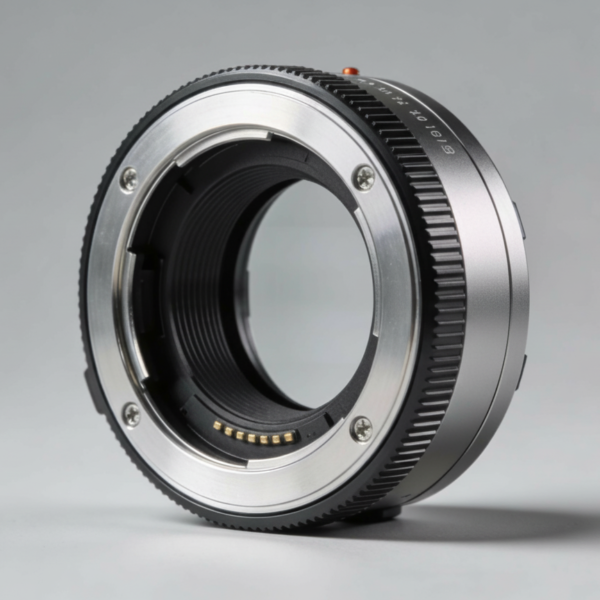
Basic Architecture: All autofocus adapters feature four essential components: (1) a lens mount matching the legacy lens being adapted, (2) a camera mount matching the target camera body, (3) electrical contact pins transmitting focus commands between camera and lens, and (4) mechanical precision ensuring optical infinity is maintained (critical for proper focus operation).
Why Standard Adapters Fail: Simple passive adapters—purely mechanical connections without electrical communication—cannot transmit autofocus signals. When mounting a Canon EF lens on a Sony E-mount mirrorless camera through a basic mechanical adapter, the camera cannot communicate focus commands to the lens motor, forcing manual focus operation. Autofocus adapters solve this by transmitting electrical signals from the camera’s autofocus system directly to the lens’s focus motor, restoring full autofocus functionality despite the mechanical incompatibility.
The Science Behind Infrared Lens Operation
Capturing Invisible Light
So how exactly do infrared lenses work? The fundamental principle is elegantly simple: they capture and focus infrared radiation emitted or reflected by objects, directing it onto an infrared sensor where it’s converted into usable data.
Every object warmer than absolute zero (−273.15°C) emits infrared radiation continuously. The hotter an object is, the more infrared energy it radiates. A thermal camera equipped with an infrared lens captures this radiation, focuses it precisely onto a specialized sensor, and transforms the invisible heat signature into a visible thermal image where different colors represent different temperatures.
The Three-Step Process
Step 1: Radiation Collection
An infrared lens’s front element gathers infrared photons from the scene. Unlike visible light lenses that use optical glass, IR lenses must be constructed from materials specially selected to be transparent at infrared wavelengths. This is the critical difference that makes infrared optics so specialized.
Step 2: Focusing and Magnification
The lens elements work together to focus incoming infrared radiation onto the sensor’s focal plane. The focal length determines the camera’s field of view and detection range. Longer focal lengths provide greater zoom capability for distant object detection; shorter focal lengths offer wider fields of view for broad scene monitoring.
Step 3: Sensor Detection and Conversion
The focused infrared radiation strikes a specialized sensor—most commonly a microbolometer in uncooled thermal cameras. The microbolometer contains thousands of microscopic thermal detectors (pixels), typically around 25μm × 25μm in size. When infrared radiation hits these pixels, it causes a measurable change in electrical resistance. Advanced electronics then convert these resistance changes into temperature data and construct the thermal image we see.
Temperature Sensitivity and Precision
Modern infrared lenses paired with microbolometer sensors can detect temperature differences as small as 0.018 millikelvin—that’s 0.000018 degrees Celsius. This extraordinary sensitivity enables applications like detecting overheating electrical components before they fail, identifying energy losses in building insulation, and monitoring critical industrial processes in real-time.
Material Science: The Heart of Infrared Lens Design
The most fundamental difference between infrared lenses and conventional optical lenses comes down to materials. Traditional optical glass, perfectly transparent to visible light, contains hydroxyl compounds that absorb infrared radiation. This makes standard glass useless for IR applications.
Infrared lens designers must select from a carefully curated palette of specialized materials, each with distinct optical properties, thermal characteristics, and cost-effectiveness.
Primary Infrared Lens Materials
Germanium (Ge)
Germanium is the workhorse material of thermal imaging. Its high refractive index (4.025 at 4μm wavelength) makes it excellent for aberration correction and compact lens design. Germanium transmits across the entire MWIR and LWIR spectrum and is the standard choice for thermal imaging cameras. However, germanium’s refractive index is highly temperature-dependent, requiring sophisticated athermal lens design to maintain focus across varying environmental conditions. At Leedsen Lens, we’ve invested heavily in athermal germanium lens design to solve this critical challenge.
Silicon (Si)
Silicon offers a compelling combination of low cost and lightweight construction, making it ideal for applications where budget and weight matter. Its transparency to certain IR wavelengths makes it suitable for MWIR laser systems and specialized spectroscopy applications. Silicon’s lower refractive index (3.4289 at 4μm) compared to germanium means slightly larger lens elements are needed for the same performance, but the cost advantage often justifies this trade-off.
Zinc Selenide (ZnSe)
ZnSe’s exceptional thermal shock resistance and low infrared absorption make it the preferred material for high-power laser applications and thermal imaging where durability is paramount. It transmits from 0.55μm to 20μm—an extraordinarily wide range—and can withstand operating temperatures up to 250°C. CO2 laser systems at 10.6μm wavelength almost exclusively use ZnSe optics. Its lower refractive index (2.4332 at 4μm) means it requires different lens geometries than germanium, but advanced polish techniques keep manufacturing costs reasonable.
Sapphire (Al₂O₃)
Sapphire ranks second only to diamond in hardness, making it the ultimate choice when mechanical robustness matters more than cost. Military optics, aerospace thermal cameras, and rugged field equipment often use sapphire. Its exceptional scratch and environmental resistance, combined with reasonable IR transmission in certain bands, justifies its premium price. Leedsen Lens uses sapphire for specialized tactical and aerospace applications where equipment must survive extreme conditions.
Zinc Sulfide (ZnS)
Harder and more chemically resistant than ZnSe, zinc sulfide excels in harsh environments where corrosion or contamination is a concern. It offers excellent transmission in both visible and infrared wavelengths, making it valuable for systems requiring simultaneous visible and thermal imaging capabilities.
Calcium Fluoride (CaF₂)
Offering wide transparency across a broad spectral range and excellent optical quality, calcium fluoride serves specialized applications where cost-effectiveness and optical performance must be balanced. It’s particularly useful for dual-wavelength systems spanning visible and infrared.
The Critical Role of Optical Coatings
Raw lens materials alone aren’t enough. When infrared light strikes an uncoated germanium surface, approximately 36% of the radiation reflects away—lost and unusable. This catastrophic loss would render thermal cameras nearly useless.
Anti-Reflection Coatings: Maximizing Transmission
This is where optical coatings become indispensable. Anti-reflection (AR) coatings are precision-engineered thin film stacks, typically 2-7 layers thick, applied to lens surfaces. These coatings work through destructive interference: alternating layers with contrasting refractive indices are arranged so that reflected light waves cancel each other out while transmitted light waves reinforce.
A high-performance AR coating can reduce germanium’s surface reflection from 36% to less than 0.5%—a 70-fold improvement. This transformation means that instead of losing more than one-third of your thermal information at each lens surface, you retain more than 99.5%.
For modern multi-element infrared lens systems with 10 or more optical surfaces, this difference is transformative. Without coatings, a 10-surface thermal lens would transmit only about 16% of incoming infrared radiation (0.64^10). With coatings, it might transmit 80-95%—an entirely different class of instrument.
At Leedsen Lens, we employ dual-band anti-reflection coatings optimized for both MWIR (3.5-5μm) and LWIR (7.8-10.5μm) applications, ensuring maximum system sensitivity across the thermal spectrum.
Specialized Coatings for Demanding Applications
Beyond standard AR coatings, specialized optical coatings serve distinct purposes:
Reflective coatings on internal mirrors achieve 99%+ reflectance, essential for beam-steering optics and optical resonators
Bandpass filters integrated into lens assemblies block unwanted wavelengths while transmitting target wavelengths, improving image contrast and reducing thermal noise
Notch filters remove specific interfering wavelengths from laser systems or astronomical observations
Protective coatings shield delicate IR materials from environmental contamination while maintaining transparency
Athermal Lens Design: Solving the Temperature Challenge
Here’s a problem that vexes all infrared lens designers: the optical properties of germanium, silicon, and other IR materials change significantly with temperature. Germanium’s refractive index shifts approximately 0.0004 per degree Celsius. In a thermal camera deployed in harsh environments—from Arctic snow to desert heat—this drift causes focal shift and image blur.
Conventional visible-light lenses have the luxury of relatively stable material properties across typical temperature ranges. Infrared lens designers must solve this challenge through sophisticated athermal design.
How Athermal Lenses Work
Athermal lens design employs three complementary strategies:
Optical Passivity: Select and combine lens materials whose temperature-dependent refractive index changes partially cancel each other out. Pairing germanium with other materials selected to have opposite temperature coefficients creates a composite system with minimal focus shift.
Mechanical Activity: The mechanical structure actively adjusts as temperature changes. Specially engineered mechanical components with precisely calibrated thermal expansion automatically shift internal lens elements, maintaining focus as the optical system’s properties drift.
Active Athermalization: Modern high-performance systems employ electronic focus adjustment. Temperature sensors monitor the system, and motorized focus mechanisms continuously optimize image quality across the entire operating temperature range.
Leedsen Lens designs athermal infrared optical systems that maintain crisp focus from −40°C to +60°C (and even wider ranges for specialized applications), crucial for applications like building thermography, industrial monitoring, and military surveillance where temperature stability determines mission success.
Why Leedsen Lens: Professional-Grade Infrared Solutions
As thermal imaging technology becomes increasingly critical across industries, the demand for precision infrared lenses grows exponentially. Leedsen Lens stands at the forefront of this revolution, offering professional lens manufacturers, camera builders, and integrators with custom infrared optical solutions optimized for their specific applications.
Our expertise spans:
Custom IR lens design for SWIR, MWIR, and LWIR applications
Athermal optical engineering maintaining performance across extreme temperature ranges
Precision lens adapters enabling seamless integration with diverse thermal camera platforms
Telescope and spectroscopy optics for scientific and research applications
Anti-reflection coatings optimized for each wavelength band
Rapid prototyping and volume production with consistent quality and performance
Whether you’re designing thermal surveillance systems, building infrared spectroscopy instruments, or integrating thermal sensors into industrial automation, Leedsen Lens delivers the optical precision that separates leading-edge thermal imaging from mediocre alternatives.
The Future of Infrared Lens Technology
The infrared optics field continues to evolve at an accelerating pace. Emerging technologies promise to reshape thermal imaging:
Flat Lens Technology (Metasurfaces)
NASA’s Microdevices Laboratory is developing flat infrared lenses using nanostructured metasurfaces—arrays of optical resonators smaller than the wavelengths they manipulate. These revolutionary designs eliminate spherical aberration, are extraordinarily lightweight, and enable new form factors for thermal cameras. Within the next 5-10 years, flat lenses may supplement traditional refractive optics across many applications.
Infrared Nanoparticle Technology
Researchers at the University of Science and Technology of China have created contact lenses embedded with rare-earth nanoparticles that convert near-infrared light (800-1600nm) into visible light humans can see. While still early-stage, this technology could eventually provide civilians with direct infrared vision capabilities previously limited to military night-vision equipment.
Advanced Coatings and Materials
New infrared-transparent materials like chalcogenide glasses and optimized coating designs continue to improve transmission, reduce absorption, and expand wavelength coverage. Future infrared lenses may achieve 99%+ transmission efficiency across multiple wavelength bands simultaneously.
Machine Learning and Thermal Image Processing
While not strictly lens technology, AI-enhanced image processing is revolutionizing what thermal cameras can detect. Combined with superior infrared optics, neural networks can identify specific threats, predict equipment failures, and diagnose medical conditions with unprecedented accuracy.
Frequently Asked Questions About Infrared Lenses
Q1: What’s the main difference between infrared lenses and regular camera lenses?
Regular camera lenses use optical glass transparent to visible light (400-700nm wavelengths). Infrared lenses use specialized materials like germanium, silicon, or zinc selenide that are opaque to visible light but transparent to infrared radiation (0.75μm to 14μm). The material selection determines the wavelength range the lens can effectively operate within.
Q2: Do infrared lenses require cooling to operate?
Most modern LWIR thermal cameras use uncooled microbolometer sensors, eliminating the need for cooling. However, many MWIR and some specialized SWIR systems use cooled photon-counting detectors that require cooling to reduce thermal noise and improve sensitivity. Cooling requirements depend on the specific sensor technology and application requirements.
Q3: Can I use a regular lens on a thermal camera?
Absolutely not. Optical glass is opaque to infrared radiation and would block the thermal signal completely. Thermal cameras must use lenses manufactured from infrared-transparent materials specifically designed for their target wavelength range. Using the wrong lens material is like trying to look through a brick wall.
Q4: Why are infrared lenses more expensive than visible light lenses?
Several factors drive IR lens costs higher: the specialized materials (germanium, for example) are more expensive and difficult to work with; precision polishing of exotic materials requires specialized equipment and expertise; smaller production volumes compared to consumer camera lenses mean no economy of scale; athermal design complexity demands more sophisticated optical engineering; and anti-reflection coatings optimized for IR wavelengths involve more sophisticated thin-film engineering than visible-light coatings.
Q5: What’s the best infrared lens material for my application?
There’s no universal best—the ideal material depends on your specific requirements: Germanium is the first choice for cost-effective MWIR/LWIR imaging. Silicon works well when low cost and light weight are priorities. Zinc Selenide is ideal if thermal shock resistance or high-power laser compatibility matters. Sapphire is essential for rugged military and aerospace applications. Leedsen Lens engineers would help you select the optimal material for your unique requirements.
Q6: How do anti-reflection coatings improve thermal imaging performance?
Without AR coatings, germanium surfaces reflect ~36% of incident thermal radiation. With multi-layer AR coatings, this drops to <0.5%. For a complex 10-surface thermal lens system, this difference means increasing transmission from ~16% to 85-95%—more than a five-fold improvement in light gathering ability. Better light gathering translates directly to sharper images, longer detection ranges, and higher temperature measurement accuracy.
Q7: What resolution can infrared lenses achieve?
Infrared lens resolution depends on the sensor pixel size. Modern thermal cameras have resolutions like 256×192, 384×288, 640×480, or higher. Unlike visible-light photography where sub-micrometer pixel sizes are standard, thermal camera pixels are typically 12-17 micrometers. This larger pixel size reflects thermal detection physics—longer infrared wavelengths require larger detector elements than shorter visible wavelengths.
Q8: How does focal length affect thermal camera performance?
Focal length determines the relationship between field of view and magnification. Longer focal lengths (50-100mm+) provide narrow fields of view but excellent long-range detection capability—ideal for spotting distant heat sources. Short focal lengths (5-10mm) provide wide fields of view—ideal for monitoring large areas at close range. Most thermal cameras use fixed-focal-length lenses optimized for their primary application, though zoom infrared lenses are increasingly common for applications requiring flexible viewing angles.
Q9: Can you see through walls with infrared lenses?
No. Infrared radiation (especially LWIR) doesn’t penetrate solid walls significantly better than visible light. Infrared lenses detect thermal radiation emitted or reflected by surface objects. They excel at seeing through darkness, fog, and smoke because these partially transmit infrared radiation, but not through opaque barriers.
Q10: How hot can infrared lens materials get before they fail?
This varies by material: Germanium can be used up to approximately 100°C before optical properties degrade significantly. Zinc Selenide maintains properties up to 250°C. Sapphire can withstand even higher temperatures. Silicon degrades at lower temperatures than germanium. Beyond these limits, the material’s refractive index changes significantly, causing focal shift and image degradation. This is why athermal design is so important for applications with broad temperature ranges.