

As a manufacturer with over 15 years of experience in the optics industry, we’ve witnessed the birth and
evolution of countless optical products. From high-precision cinema lenses and robust lens adapters to sophisticated telescope optics and custom hardware, we understand the dedication behind every piece of glass. We spend thousands of hours in our factories, meticulously crafting perfect sharpness, c
ontrast, and coating processes.
If you find your photos look “soft,” “veiled,” or lack their usual sharp contrast, don’t rush to blame the focusing system; you may be experiencing camera lens haze. In this in-depth article, we’ll shed our lab coats and, from a manufacturer’s perspective, explain in simple terms what this is, why it happens, and how to salvage your equipment.
So what exactly is camera lens haze?
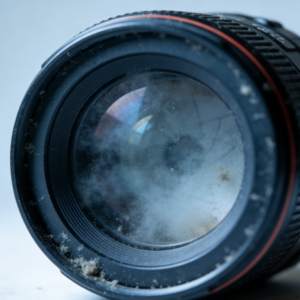
Simply put, camera lens haze refers to a cloudiness that forms on the inner surface of a lens element. Unlike dust (which is usually a small, clearly visible dot on a surface), haze is a thin, uniform film that scatters light as it passes through the lens barrel.
Imagine driving a car with a dirty windshield towards the setting sun. Glare spreads across the entire field of view, obscuring all detail. Inside the lens, this film reduces light transmission and significantly reduces micro-contrast in the image.
From a manufacturing perspective, camera lens haze can generally be cate
gorized into three specific types, each with different causes:
1. “Oily” Haze (Volatile Condensation)
This is the most common form we see in older lenses, but it can also occur in modern lenses if the materials used are substandard. Inside every lens are mechanical parts—helicoids for focusing and aperture blades—that require lubrication. If the manufacturer uses low-quality grease, or if the lens is stored in a high-temperature environment (like a car dashboard in summer), the grease evaporates. It turns into a gas, drifts onto the cooled glass lens element, and re-condenses into a thick, oily film. This is a typical example of camera lens haze.
2. Biological Haze (Mold)
Glass isn’t organic, but the dust and grease inside the lens are. If
moisture gets inside the lens—perhaps because you’re shooting in a rainforest or leaving the lens in a damp basement—mold spores will sprout. In its early stages, the mold looks like a spider web, but as it dies or spreads, it leaves a cloudy, etched layer, forming a difficult-to-remove camera lens haze.
3. Structural Haze (Glue Separation)
In optical design, we often glue two pieces of glass together to correct chromatic aberration (purple fringing). Historically, manufacturers used a natural resin called “Canada Balsam.” After a few decades, this resin can dry, crystallize, or turn white. This is what we call “glue separation.” While our factory now uses modern, high-grade synthetic UV-cured adhesives to prevent this, it’s still a major problem for photographers who prefer “vintage lenses.”
How to identify camera lens haze in your lens?
You can’t usually spot haze just by looking at the front of the lens. T
he glass surface may appear spotless. As manufacturers, we use collimators and projectors to test this, but you can also do a simplified quality control (QC) check at home, which we call: the Flashlight Test.
Open the aperture:
Set the lens aperture to its widest setting (if using an adapter or an older lens, manually hold down the aperture lever).
Shine a light:
Take a bright LED flashlight (a phone flash will do, but a tactical flashlight is better) and shine it into the rear element of the lens.
Look from the front:
Tilt your head and look in from the front element.
What you’re looking for:
Dust: Sharp, clear dots. This is normal and has almost no impact on image quality.
Haze: A luminous, milky-white haze that illuminates
the entire glass lens. It looks like someone breathed on the glass, but it’s inside. If the glass looks “milky” instead of crystal clear, then congratulations (or unfortunately), you’ve encountered camera lens haze.
Impact on Image Quality
Why worry about this? Because camera lens haze attacks what photographers value most: contrast.
Blacks Turn Gray: Your deep shadow areas will appear grayish.
Highlight Blowout: A halo effect will appear around bright light sources.
Decreased Sharpness: While the lens may still be able to discern
details, that “razor-sharp, creamy” acutance will be lost.
Sometimes, portrait photographers might intentionally aim for a slight camera lens haze for a “vintage, dreamy” effect. But for landscape, architectural, or product photography, it’s a disaster.
Can Camera Lens Haze Be Repaired?
This is the question we get asked most often. The answer is: It depends.
The Good News
If the camera lens haze is caused by volatile lubricant (oily haze), it can usually be cleaned. A skilled technician can disassemble the lens, clean the glass elements with chemical solvents, re-lubricate the mechanical structure with modern synthetic damping grease (which we highly recommend), and then reassemble it. Lens performance can be restored to 95-100% of its original condition.
The bad news
If the camera lens haze is caused by long-standing mold or glue separation, the damage can be permanent. Mold secretes enzymes that physically “etch” the glass coating and even th
e glass itself. Even if you wash off the mold, the “scar” remains and will permanently scatter light. Similarly, re-gluing separated lenses is an extremely complex and expensive process, often exceeding the value of the lens itself.
Prevention: Advice from the manufacturer:
As a company that manufactures lenses, adapters, and telescopes, we strive to make our prod
ucts resistant to harsh environments, but no optics is invincible. Here’s how to protect your investment:
Control humidity: This is the first rule. Store your lenses in a dehumidifier box (electronic dehumidifier cabinet) with the humidity set at 40-50%. If that’s not possible, use a sealed box with plenty of silica gel desiccant and replace the desiccant regularly.
Avoid extreme temperatures: Never leave your camera bag in a car exposed to direct sunlight. High temperatures accelerate the outgassing of internal lubricants, forming the oily camera lens haze we discussed earlier.
Frequent Use: Surprisingly, lenses that are stored on racks for extended periods are more prone to haze. Focus threads become stiff, and stagnant air promotes mold growth. Rotating the focus ring and aperture blades promotes airflow and maintains lubrication of mechanical components.
About Our Manufacturing Process:
In our factory, we take proactive measures to ensure that camera lens haze is a thing of the past for our customers.
Synthetic Lubricants: We use high-grade, high-temperature resistant synthetic greases that do not evaporate or outgass even at extreme temperatures.
Cleanroom Assembly: Our lenses are assembled in ISO-certified cleanrooms, ensuring that no organic spores are trapped inside the lens barrel during assembly.
Modern Adhesives: We use UV-cured optical adhesives that are chemically stable and will not yellow or separate over long-term use.
When you buy a lens, you’re not just buying glass; you’re buying the engineering integrity that brings it together.